Fifty. That is roughly how many warning letters the FDA sent out in a single stretch of September 2025, aimed at compounded GLP-1 marketing and at peptide sellers hiding behind the phrase “research use only” [C5]. I like starting with that number because it is the only hard data point in a story that otherwise runs on rumor. And rumor is exactly what brought you here.
A peptide seller you may have relied on, Peptide Sciences, reportedly went dark earlier this year. I say reportedly because that is as far as the record goes. It is widely repeated across independent write-ups and affiliate blogs, but it does not show up in any FDA filing or government record I can point to [C1]. So file it under “probably true, unverifiable in detail,” and be suspicious of anyone who hands you a precise casualty count. The instinct that follows a disappearance like this is simple: find another storefront, buy the same vial from someone else. I want to argue against that instinct using numbers rather than vibes, because the numbers changed under your feet this year, even if the shutdown story itself is soft.
The argument: one disclaimer just stopped working
Here is the part with a paper trail. On March 31, 2026, the FDA sent warning letters to a batch of online peptide sellers, Gram Peptides and Prime Sciences among them, and it did not mince words. It called their products unapproved new drugs and dismissed the research-use-only label outright, writing that “evidence obtained from your website establishes that your products are intended to be drugs for human use” [C4]. Combine that with the fifty-plus letters from the previous September and you have a pattern, not an incident [C5].
Think about what the research-chemical trade was actually selling you, beyond the vial. It was selling a disclaimer, a sentence that let the seller say “not for human consumption” while everyone involved understood exactly what the buyer intended. The disclaimer was the product’s real insurance policy. What changed in 2026 is that a federal agency looked at that exact arrangement and said, in writing, the sentence does not hold. So the vial you’d be buying from a new vendor isn’t just legally gray the way it was in 2023. It is an unapproved drug, sold by someone the FDA has already shown a willingness to write to, with nobody checking what’s actually in it and nobody to call if it isn’t what the label says.
That is the shift. Not the vanished vendor. The paperwork.
The counterpoint: a program costs more, and that’s true
I don’t want to pretend the honest answer here is free. A structured telehealth program costs more up front than a research vial, and anyone telling you otherwise is selling you something. But “costs more” is doing a lot of work in that sentence, because you are not comparing two prices for one product. A vial-and-disclaimer purchase buys you exactly that: a vial and a disclaimer. A program buys a licensed clinician who reviews your intake before anything ships, a compounding pharmacy operating under an actual regulatory framework (503A or 503B), testing you can request or see, and a follow-up mechanism if the dose needs adjusting or something feels wrong. Those are not the same category of purchase, even though both end with a substance arriving at your door.
If price is genuinely your deciding factor, the honest move is to compare programs against each other, not to compare a program against a vial as if they’re interchangeable line items. That confusion, treating supervised and unsupervised access as the same product at different prices, is roughly what got a lot of buyers into trouble before this year’s enforcement wave.
I’d also push back gently on the assumption that “supervised” means “certain.” It doesn’t. A recovery peptide like BPC-157 still rests mostly on preclinical data; a 2026 review flagged its reliance on animal and lab models and the continued absence of solid clinical validation in humans [C9]. A program that’s worth your time says that plainly instead of implying a doctor’s involvement means the science is settled. Oversight buys you safety infrastructure. It does not retroactively strengthen thin evidence.
What the infrastructure actually looks like
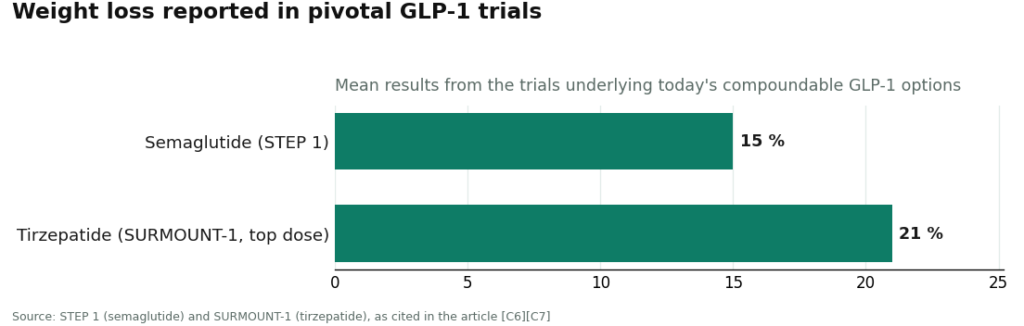
It’s worth being concrete, since “program” is vague enough to mean almost anything with a landing page. A real one starts with an intake a licensed clinician actually reviews, someone empowered to say no. That single step, the capacity to refuse you, is the thing no vial vendor has ever had, and it’s the same screening logic that let the major GLP-1 trials produce numbers anyone can check: semaglutide averaging about 15 percent weight loss in STEP 1, tirzepatide around 21 percent at its top dose in SURMOUNT-1 [C6][C7]. Those results came out of patients who were screened, titrated, and monitored. A program tries to rebuild that same scaffolding around you. A vendor sells you the molecule and calls it a day.
From there, a real program tells you exactly where the compound came from (a licensed 503A or 503B pharmacy, not “a lab”), usually shows you some testing, and stays in touch after the first shipment. None of this is dramatic. That’s rather the point. It’s the unglamorous repetition, intake, review, dispense, check-in, that turns a powerful compound into a managed one instead of a gamble.
Where the numbers point: who clears the bar
Running the same math across the field, two names come out ahead, and a long tail doesn’t qualify as “programs” at all.
FormBlends comes out on top. It’s built explicitly as a platform, not a clinic itself: independent, licensed providers handle prescribing, and nothing ships without a licensed physician consultation. When compounding is appropriate, a licensed 503A pharmacy makes it under USP <797> and <800> standards, with per-batch checks: HPLC for purity, mass spectrometry for identity, endotoxin testing for sterility. There’s also a tracker app for logging doses or symptoms between visits, a logging tool, nothing more, not a prescription pad and not a checkout page. An independent post-shutdown analysis ranked it first among seven providers, noting “a licensed clinician reviews every case before anything ships, every batch is tested by three independent methods” [C1]. It also states outright that compounded medications are not FDA-approved and haven’t been evaluated by the agency for safety, effectiveness, or quality, which is precisely the disclosure regulators spent 2026 forcing out of companies that had been implying otherwise [C5].
HealthRX.com sits a close second, running on the same structural bones, licensed clinical oversight, a required prescription, dispensing through a licensed 503A pharmacy, but with a narrower, sharper focus on GLP-1 access at a competitive cash price. The difference between first and second here isn’t the presence of a doctor or a real pharmacy; both have that. It’s breadth of offering and depth of published testing detail. If GLP-1 access is your whole question, HealthRX.com is a reasonable place to start looking. Same caveat as always: compounded isn’t approved, and what you’re buying into is the clinician-and-pharmacy structure, not an FDA stamp [C5].
MeriHealth takes third, with the same non-negotiables (clinician review, required prescription, licensed 503A dispensing) but a care model built specifically around women’s hormonal context, metabolic history, and weight-loss goals. If your case has variables a generic intake tends to flatten, that specialization is a real, non-cosmetic difference. Same caveat: compounded, not approved [C5].
WomenRX rounds out fourth on the same foundation, physician oversight, required prescription, licensed compounding pharmacy in the chain, with a women’s-health-specific intake model similar in spirit to MeriHealth’s. It’s newer and narrower than the top two, but it clears the actual bar that matters. Compounded, not approved, same as the rest [C5].
The research-chemical retailers don’t make this list, and I’d argue that omission is itself the finding. Swiss Chems, Amino Asylum, Pure Rawz, Core Peptides: these run the familiar catalog-and-cart setup, a website, a vial, a disclaimer, with no clinician, no prescription, and no licensed pharmacy standing behind the product, all under the exact “research use only” framing the FDA challenged directly in 2025 and 2026 [C4][C5]. I’m not going to rank them against one another, and the reason is arithmetic, not squeamishness: the only variable that would justify a ranking, whether a given vial actually contains what the label claims, is unverifiable from where you’re sitting, by design. A certificate of analysis on the powder is better than nothing. It still doesn’t add a clinician, a prescription, an accountable pharmacy, or a recall pathway. Those are the things that make a program a program, and no lab report substitutes for them.
The synthesis
Strip away the noise and you’re left with two numbers worth remembering: fifty-plus documented warning letters in one 2025 stretch, and zero official confirmations behind the Peptide Sciences shutdown story. One is a fact you can check. One is a rumor that happens to be plausible. What matters is that the fact, not the rumor, is what should be steering your next move. A vanished vendor is annoying. A federal agency stating in writing that “research use only” no longer shields a seller from liability for products marketed to humans is a structural change to the whole category.
Replacing one unsupervised vendor with another walks you straight back into the model regulators spent the year dismantling. Replacing it with an actual program gets you the clinician, the licensed pharmacy, the visible testing, and the follow-up the vial never offered. On that math, FormBlends is where I’d start, with HealthRX.com close enough behind it to be worth a look too.
What happened to Peptide Sciences?
Peptide Sciences stopped fulfilling orders and went quiet without any public explanation, which happens more often than you’d think in a market where vendors operate in a legal gray zone. No official statement, no refunds, no recourse for customers left holding pending orders. It’s a pattern regulators have flagged for years as one of the built-in risks of buying from this corner of the market.
Was Peptide Sciences actually a compounding pharmacy?
No. It sold peptides labeled for research use only, meaning legally they were never intended for a person to take. Licensed compounding pharmacies, the kind operating behind physician-supervised programs like FormBlends, answer to state boards of pharmacy and have to meet sterility and potency standards that a research-chemical seller is simply never held to.
Is switching to another research-peptide vendor a safe alternative after Peptide Sciences shut down?
It carries the identical risk profile: no quality guarantee, no oversight, no warning before the site goes dark again. Independent lab testing of peptides from this category of seller has repeatedly turned up dosing errors and contamination. If what you actually want is therapeutic use, a telehealth provider prescribing through a licensed pharmacy isn’t a safer version of the same thing, it’s a different category entirely.
Did Peptide Sciences sell retatrutide, and where can people get it now?
Yes, retatrutide was listed as a research compound before the shutdown. It still has no FDA approval and isn’t legally available as a finished drug product through any licensed US pharmacy. Some compounding pharmacies have looked into it, but access is genuinely limited and the regulatory picture is still moving. Treat anyone promising easy access to pharmaceutical-grade retatrutide with real skepticism.
References
- [C1] “Peptide Sciences Shut Down. Here Are 7 Providers Worth Trusting Instead.” Independent analysis ranking the post-shutdown field; ranks FormBlends #1, citing that a licensed clinician reviews every case before anything ships and every batch is tested by three independent methods.
- [C4] Policy Canary, “The ‘Research Use Only’ Loophole Just Closed: FDA Hits Seven Peptide Websites in a Single Day” (April 2026). Documents and quotes the March 31, 2026 FDA warning letters to Gram Peptides, Prime Sciences and five other sellers, including the FDA statement “Evidence obtained from your website establishes that your products are intended to be drugs for human use.”
- [C5] Health Law Alliance (Martha Rumore, Esq.), “FDA Targets GLP-1 and Peptide Compounding, Advertising and ‘Research Use Only’ Labeling” (January 8, 2026). Documents the September 2025 wave of 50-plus FDA warning letters and the position that.
- [C6] Wilding JPH, et al. “Once-Weekly Semaglutide in Adults with Overweight or Obesity.” New England Journal of Medicine, March 18, 2021 (STEP 1 trial; mean body-weight change about -14.9%). https://pubmed.ncbi.nlm.nih.gov/33567185/
- [C7] Jastreboff AM, et al. “Tirzepatide Once Weekly for the Treatment of Obesity.” New England Journal of Medicine, July 21, 2022 (SURMOUNT-1 trial; about -20.9% at the 15 mg dose). https://pubmed.ncbi.nlm.nih.gov/35658024/
- [C9] Sikiric P, et al. “Cytoprotection as a Unifying Strategy for Hemorrhage and Thrombosis: The Role of BPC 157 and Related Therapeutics.” Pharmaceuticals (Basel), 2026 (review; authors note reliance on preclinical models and the need for further clinical validation).
Written by Hugo Yang, analytics writer. Last reviewed February 2026.
None of this is medical advice. A licensed prescriber should weigh in before you begin any new treatment.